

by Anita Vincent
You have been told, O mortal, what is good,
and what the LORD requires of you:
Only to do justice and to love goodness,
and to walk humbly with your God.
Micah 6:8
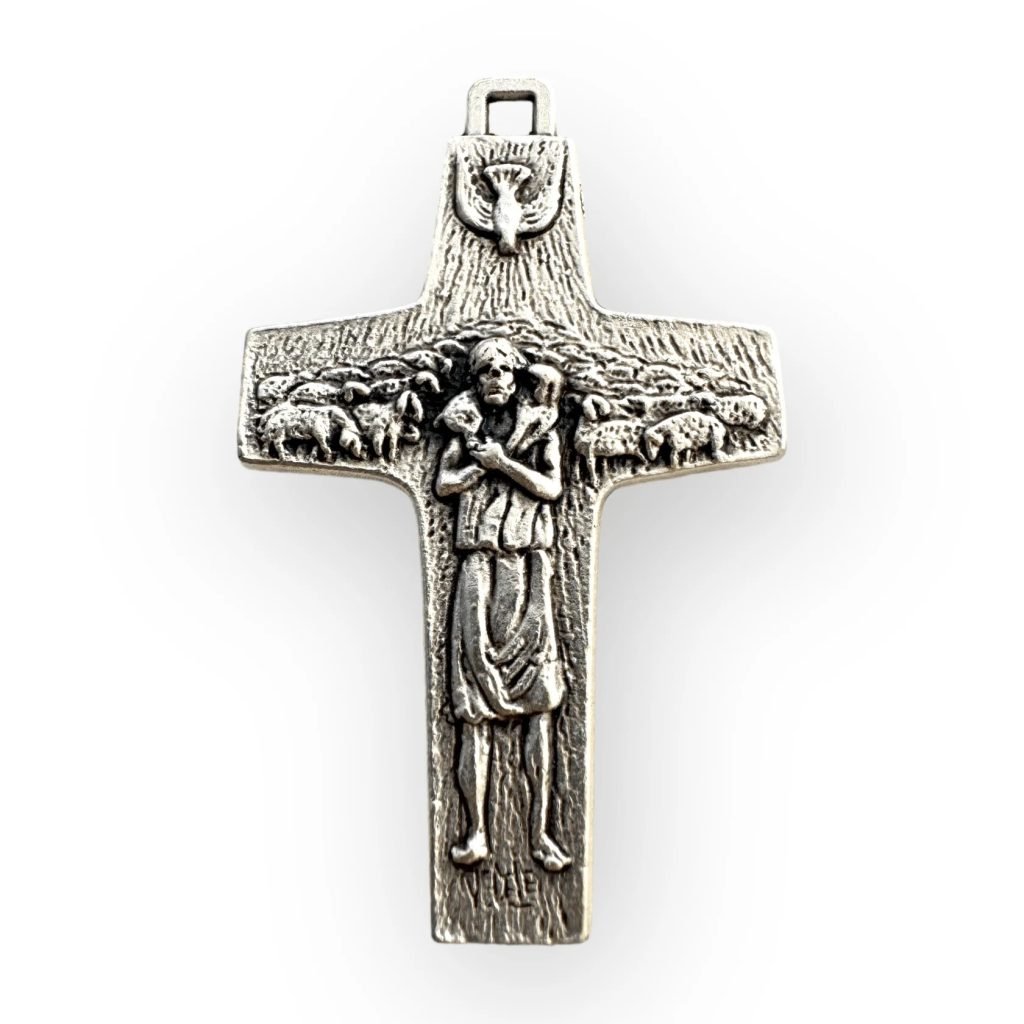
The “Vedele Cross” was a gift to the Archbishop of Buenos Aires, Jorge Bergoglio, in 1998. Embracing it as the symbol of his calling to be the kind of shepherd leader that Jesus enjoins Peter to be (John 21:15-17), he chose to live in solidarity with his flock and to meet and minister to them where they were.
As Archbishop of Buenos Aires, he lived in a small apartment with an older priest and tended to his own simple needs. He often traveled by train to the slums on the outskirts of Buenos Aires to visit and minister to the poor. As he listened to their stories and held them to comfort them, their tears fell on the cross on his chest. As he prayed with them, their hands would hold his cross along with his.
This symbol of his and Jesus’ incarnation was not set aside as he stepped out to the cheers of the people gathered in St. Peter’s Square upon his election as Pope. Deliberately choosing the name Francis after St. Francis of Assisi – “the man of poverty, the man of peace, the man who loves and protects creation,” he too made his hallmark to be justice, goodness, and humility in both his spirit and his presence.
Pope Francis went in search of the sheep who were on the margins, disenfranchised, and ostracized. He urged the clergy to relinquish titles and pageantry and replace them with compassion and welcome. Much like the early Christians, Pope Francis stepped into the compassion gap, thoughtfully taking on those worried about innocence and defilement coming through those with whom the church is called to walk. He shouldered the mantle as a minister to the “least of [God’s] people,” (Matthew 25:40) on the edges of the church. He knew that to make space for the Kindom of God to be visible, he had to speak.
His mission was to unite people – within and outside the church; to reach the “existential margins,” so that the church can again be a welcoming place of mercy; to stand up for the dehumanized and abandoned; and to teach us to be bold in our evangelization of the immense love of God. In the last hours of his life, he made a plea to the world for each person to uphold the inviolable dignity of every other person, for peace and unity.
The cross, with the Shepherd and the Holy Spirit, aided his prayers for guidance and strength. He remained committed to justice, goodness, and the humble walk with God and his fellow human persons. Through the many challenges he faced, there was the constant flow of “hope that does not disappoint.” (Romans 5:5) He constantly fixed his gaze on the culmination of God’s Project, the Parousia. He showed us how to work to build the Kindom of God in this world, and how to keep alive the hope for the fullness of the Kindom to come. Pope Francis designated this Jubilee Year of 2025 as a Year of Hope. (Spes non confundit, 2024)
While his homegoing leaves us with a sense of dejection and wariness for the future, his last words in public urge us to “not yield to the logic of fear” but to “be drawn to this hope! Through our witness, may hope spread to all those who anxiously seek it. May the way we live our lives say to them in so many words: ‘Hope in the Lord! Hold firm, take heart and hope in the Lord!’ (Ps 27:14) May the power of hope fill our days, as we await with confidence the coming of the Lord Jesus Christ, to whom be praise and glory, now and forever.”
He embodied the joy of the toddler, the inquisitiveness of the elementary child, the adolescent’s ability to be transformed, and the young adult’s industry to the greater good. His kind smile, sparkling eyes, hands raised in welcome and blessing… and the cross that he chose to wear close to his heart, as a symbol of his pastoral commitment to the global church, indeed to all of humanity in this age, will remain his lasting legacy to the whole world. To the point of crossing the Jordan, he did justice, loved goodness, and walked in the fullness of humility with God and with his beloved community, all the world.
2 Responses
Well said. The phrase “compassion gap” is particularly apt for our place and time. He was aware of the gender “fracture” as well. We have a long way to go to close the “compassion gap” he both pointed to and began to address.
Dear Anita, this is such a beautiful reflection on the life and legacy of Pope Francis! Thank you